Armistice Day 2026

Lest We Forget. Armistice Day Centenary Armistice Day, which is also known as Remembrance Day or Poppy Day, is commemorated every year on 11 November and this year is its 108th year since the guns fell silent (1918 – 2026).

Armistice Day marks the armistice signed between the Allies of World War I and Germany at Compiègne, France, for the cessation of hostilities on the Remembrance DayWestern Front of World War I, which took effect at eleven o’clock in the morning — the “eleventh hour of the eleventh day of the eleventh month” of 1918. The armistice initially expired after a period of 36 days. A formal peace agreement was only reached when the Treaty of Versailles was signed the following year.[1]

In South Africa one of the first instances where this tradition was honoured was at a church service in Cape Town. The city was in mourning after the publication of South Africa’s first casualty list from Word War I in 1916. A local businessman, Mr. J.A. Eggar, proposed that the congregation at a church service should keep a minute’s silence to honour the ‘Fallen.’ At the time it received no publicity.

Cape Town two-minute silence 1918 (Pic: SA History Online)On 27 October 1919, the famous South African author[2], politician and mining financier, Sir James Percy FitzPatrick proposed through Lord Milner, the former High Commissioner for South Africa, the idea of a two-minute silence, which proposition was presented to King George V that a moment of silence be observed annually on November 11 in honour of the dead of World War I. This had been a daily practice in Cape Town from April 1918 onward, since being proposed by Sir Harry Hands[3]. On 17 November, King George proclaimed that ‘at the hour when Armistice came into force, the 11th hour of the 11th day of the 11th month, there may be for the brief space of two minutes a complete suspension of all our normal activities . . . so that in perfect stillness, the thoughts of everyone may be concentrated on reverent remembrance of the glorious dead.’

Delville-wood, 1916 First World War Trenches People observe a one or more commonly a two-minute moment of silence at 11:00 a.m. local time. It is a sign of respect for, in the first minute, the estimated 20 million people who died in the war (1914-1918), and in the second minute dedicated to the living left behind, generally understood to be wives, children and families left behind but deeply affected by the conflict.

images images-1

We remember all who have given their lives in both the World Wars I & II and all other wars of conflict around the world, not forgetting the South African soldiers who lost their lives in WWI&II, the Border War and the Rhodesian Bush War defending all people groups against communism and socialistic tyranny.

13  Greater love hath no man than this, that a man lay down his life for his friends. ~ John 15:13

16  Hereby perceive we the love of God, because he laid down his life for us: and we ought to lay down our lives for the brethren. ~ 1 John 3:16

Memorial Wall

However, there is another war that rages on daily and this conflict is for the souls of men. As millions of unsaved souls have been lost in past wars, as Christians we are commissioned to reach the souls of men who stand upon the edge of hell and damnation in the eternal lake of fire which is the second death (read Revelation 20:14, 21:8). For as a Christian this Scripture is true, “For we wrestle not against flesh and blood, but against principalities, against powers, against the rulers of the darkness of this world, against spiritual wickedness in high places (Ephesians 6:12). And, “For though we walk in the flesh, we do not war after the flesh: (For the weapons of our warfare are not carnal, but mighty through God to the pulling down of strong holds;) (2 Corinthians 10:3,4).

For we have been warned,

17  For the time is come that judgment must begin at the house of God: and if it first begin at us, what shall the end be of them that obey not the gospel of God?
18  And if the righteous scarcely be saved, where shall the ungodly and the sinner appear? ~ 1 Peter 4:17,18

22  And of some have compassion, making a difference:
23  And others save with fear, pulling them out of the fire; hating even the garment spotted by the flesh. ~ Jude 22,23

15  And he [JESUS] said unto them, Go ye into all the world, and preach the gospel to every creature.
16  He that believeth and is baptized shall be saved; but he that believeth not shall be damned.
~ Mark 16:15,16

Soli Deo Gloria____________________

Related Blog-post: Remembrance Day 2015

Sources: King James Bible, Wikipedia, SAMVOA (South African Military Veterans Organisation of Australasia)

1 Shushkewich, Val (12 September 2005). The real Winnie : a one-of-a-kind bear. Natural Heritage Books. p. 42. ISBN 9781554883509.

2 Author of Jock of the Bushveld. Originally published in 1907. 

3 “Cape Town’s WWI Mayor – Sir Harry Hands” (PDF). wordpress.com.

The Gunpowder Plot – Guy Fawkes (Repost 2026)

C. H. Spurgeon The Daily Devotion by C. H. Spurgeon makes reference on this day to the Gunpowder Plot against King James I which today is “celebrated” as Guy Fawkes Night.

November 5

Morning

“No weapon that is formed against thee shall prosper.”
– Isa 54:17

17  No weapon that is formed against thee shall prosper; and every tongue that shall rise against thee in judgment thou shalt condemn. This is the heritage of the servants of the LORD, and their righteousness is of me, saith the LORD. ~ Isaiah 54:17

This day is notable in English history for two great deliverances wrought by God for us. On this day the plot of the Papists to destroy our Houses of Parliament was discovered, 1605.

“While for our princes they prepare
In caverns deep a burning snare,
He shot from heaven a piercing ray,
And the dark treachery brought to day.”

And secondly-to-day is the anniversary of the landing of King William III, at Torbay, by which the hope of Popish ascendancy was quashed, and religious liberty was secured, 1688.

This day ought to be celebrated, not by the saturnalia of striplings, but by the songs of saints. Our Puritan forefathers most devoutly made it a special time of thanksgiving. There is extant a record of the annual sermons preached by Matthew Henry on this day. Our Protestant feeling, and our love of liberty, should make us regard its anniversary with holy gratitude. Let our hearts and lips exclaim, “We have heard with our ears, and our fathers have told us the wondrous things which thou didst in their day, and in the old time before them.” Thou hast made this nation the home of the gospel; and when the foe has risen against her, thou hast shielded her. Help us to offer repeated songs for repeated deliverances. Grant us more and more a hatred of Antichrist, and hasten on the day of her entire extinction. Till then and ever, we believe the promise, “No weapon that is formed against thee shall prosper.” Should it not be laid upon the heart of every lover of the gospel of Jesus on this day to plead for the overturning of false doctrines and the extension of divine truth? Would it not be well to search our own hearts, and turn out any of the Popish lumber of self-righteousness which may lie concealed therein?

Gunpowder Plot and your KJV Bible

Guy Fawkes Gun-powder Plot. A late 17th or early 18th century report of the plot.Issue Date: May/June 2013

While the U.S. has its Fourth of July, complete with fireworks and revelry, England also has November 5 and it appears their celebration outdoes the USA’s. All over the country “bonfire societies” field multiple parades complete with massive firework displays. One example in the news recently was a small town of 16,000 called Lewes, which hosts some 60,000 visitors who joined the festivities.

So, what is so special about November 5? It’s Guy Fawkes Day!

Those who know the history of the holiday, know the significance of the “gunpowder plot” that got Fawkes and some of his buddies executed. But, if Fawkes had succeeded in igniting the fuse to 36 barrels of gunpowder, you and I might have a very different Bible to read today.

The year was 1605, just 6 years before the publication of the King James Bible that became the standard English scriptures for some 400 years. King James had been petitioned by the Puritans to authorize the translation of a “new and completely accurate” English Bible. He immediately commissioned over 50 scholars from Oxford and Cambridge to begin the work. The men chosen were the most learned of their day not only in linguistics but biblical theology. Many of them were fluent in up to 14 languages.

All this was happening in the middle of a pitched battle between the leaders of the Reformation and the Vatican. And the Bible was the prize in that war. For over 100 years the Reformers had fought to print the Bible in the language of the people. The Vatican had commissioned the Jesuits and the Dominicans with the task of destroying those Bibles. Politics had become one of the battlefields with the rulers of England alternating between Protestant and Catholic.

At this point, King James was Protestant and almost literally had a bull’s eye on his back. Jesuit agents cooked the “gunpowder plot” to tunnel under the Parliament building and set off a massive explosive while it was in session. Their hope was to kill King James and as many of the Members of Parliament as possible.

Guy Fawkes was enlisted by the pope to carry out the plan. He and about half-a-dozen other men started the tunnel and eventually positioned 36 barrels of gunpowder in place. In their attempt to carry out their plan, they met one problem after another so that, looking back, the Lord was surely toying with their little plan. During the digging, they hit an unexpected wall underground. But a cellar was discovered that gave them the required access. Next, Parliament delayed meeting for several months and the powder got wet and had to be replaced. Finally one of the men wrote a letter warning a Catholic friend to stay away from the building on a certain date. The letter ended up in the hands of the king who discovered the scheme just hours before the targeted meeting.

November 5 was legislated a national day of thanksgiving for deliverance from “papists.” Today, it is celebrated as a fun festival with few recognizing the continued dangers of Roman Catholicism. But had the pope not lost that battle, you and I might be reading a Roman Catholic Bible, if we were even allowed to possess one.

But the story of the war waged by the Vatican to stop God’s word for the common people is not over. Today gunpowder is not the weapon of choice, it is ecumenism and polluted bibles. David W. Daniels explains many fascinating details of this 500-year war and the present state of hostilities, in his book, Did the Catholic Church Give Us the Bible?, available from Chick Publications.

Gunpowder treason and plot

The Gunpowder Plot of 1605, in earlier centuries often called the Gunpowder Treason Plot or the Jesuit Treason, was a failed assassination attempt against King James I by a group of provincial English Catholics led by Robert Catesby.

The plan was to blow up the House of Lords during the State Opening of Parliament on 5 November 1605, as the prelude to a popular revolt in the Midlands during which James’s nine-year-old daughter, Elizabeth, was to be installed as the Catholic head of state. Catesby may have embarked on the scheme after hopes of securing greater religious tolerance under King James had faded, leaving many English Catholics disappointed. His fellow plotters were John and Christopher Wright, Robert and Thomas Wintour, Thomas Percy, Guy Fawkes, Robert Keyes, Thomas Bates, John Grant, Ambrose Rookwood, Sir Everard Digby and Francis Tresham. Fawkes, who had 10 years of military experience fighting in the Spanish Netherlands in the failed suppression of the Dutch Revolt, was given charge of the explosives.

Monteagle letter. An anonymous letter, sent to William Parker, 4th Baron Monteagle, was instrumental in revealing the plot's existence. Its author's identity has never been reliably established, although Francis Tresham has long been a suspect. Monteagle himself has been considered responsible, as has Salisbury The plot was revealed to the authorities in an anonymous letter sent to William Parker, 4th Baron Monteagle, on 26 October 1605. During a search of the House of Lords at about midnight on 4 November 1605, Fawkes was discovered guarding 36 barrels of gunpowder—enough to reduce the House of Lords to rubble—and arrested. Most of the conspirators fled from London as they learned of the plot’s discovery, trying to enlist support along the way. Several made a stand against the pursuing Sheriff of Worcester and his men at Holbeche House; in the ensuing battle, Catesby was one of those shot and killed. At their trial on 27 January 1606, eight of the survivors, including Fawkes, were convicted and sentenced to be hanged, drawn and quartered.

Details of the assassination attempt were allegedly known by the principal Jesuit of England, Father Henry Garnet. Although he was convicted of treason and sentenced to death, doubt has been cast on how much he really knew of the plot. As its existence was revealed to him through confession, Garnet was prevented from informing the authorities by the absolute confidentiality of the confessional. Although anti-Catholic legislation was introduced soon after the plot’s discovery, many important and loyal Catholics retained high office during King James I’s reign. The thwarting of the Gunpowder Plot was commemorated for many years afterwards by special sermons and other public events such as the ringing of church bells, which have evolved into the Bonfire Night of today.

The following poem has been handed down through time, elements of which are still reiterated even today. It sums up how the Protestants felt about the events that unfolded on that day in 1605:

“Remember, remember!
The fifth of November,
The Gunpowder treason and plot;
I know of no reason
Why the Gunpowder treason
Should ever be forgot!

Guy Fawkes and his companions
Did the scheme contrive,
To blow the King and Parliament
All up alive.
Threescore barrels, laid below,
To prove old England’s overthrow.
But, by God’s providence, him they catch,
With a dark lantern, lighting a match!

A stick and a stake
For King James’s sake!
If you won’t give me one,
I’ll take two,
The better for me,
And the worse for you.

A rope, a rope, to hang the Pope,
A penn’orth of cheese to choke him,
A pint of beer to wash it down,
And a jolly good fire to burn him.
Holloa, boys! holloa, boys! make the bells ring!
Holloa, boys! holloa boys! God save the King!
Hip, hip, hooor-r-r-ray!”

However, true Christians do not condone the violent language that is reflected in this poem especially in the last stanza.

This villainous plot had everything to do with King James the 1st’s commission of the “Authorised Version” of the Holy Bible, known as the King James Bible, in 1604 and the gunpowder plot took place in 1605.

Soli Deo Gloria

________________________________

Sources: Chick.com Publications and Wikipedia

Human Rights Day 2026

HUMAN RIGHTS DAY

~ Are all treated equally? ~

~ With Compliments ~

Repent and Believe Logo

Gary Stephen Crous

Cell: +27 (0) 72 221 1233

E-mail: luke9.23evangelism@gmail.com

Website: http://www.luke923evangelism.wordpress.com

Introduction

Human Rights Day is celebrated as a public holiday in South Africa each year on March 21. As part of this introduction an extensive quote that appears at the Parliament of the Republic of South Africa’s website[1] is quoted here to record what the government regards as human rights, quote:

What are human rights?

Human rights are rights that everyone should have simply because they are human. In 1948, the United Nations defined 30 articles of human rights in the Universal Declaration of Human Rights. It established universal human rights on the basis of humanity, freedom, justice, and peace.

South Africa has included indivisible human rights in our own Bill of Rights, Chapter 2 of the Constitution of the Republic of South Africa, 1996. The articles of our Constitution can only be changed by a two-thirds majority in Parliament, which means it is difficult for anyone, including the government, to take away the basic rights of a citizen.

The Bill of Rights preserved in our Constitution is the cornerstone of our constitutional and representative democracy. The Constitution as our supreme law means that no laws may be passed that goes against it. The Bill of Rights also comprehensively addresses South Africa’s history of oppression, colonialism, slavery, racism and sexism and other forms of human violations. The Bill of Rights embeds the rights of all people in our country in an enduring affirmation of the democratic values of human dignity, equality and freedom.

Human Rights Day, 21 March

Human Rights Day in South Africa is historically linked with 21 March 1960, and the events of Sharpeville. On that day 69 people died and 180 were wounded when police fired on a peaceful crowd that had gathered in protest against the Pass laws. This day marked an affirmation by ordinary people, rising in unison to proclaim their rights. It became an iconic date in our country’s history that today we commemorate as Human Rights Day as a reminder of our rights and the cost paid for our treasured human rights. [. . .]

Modern era

When South Africa held its first democratic election, with Nelson Mandela elected as its first democratic President, 21 March, Human Rights Day was officially proclaimed a public holiday.

On Human Rights Day, South Africans are asked to reflect on their rights, to protect their rights and the rights of all people from violation, irrespective of race, gender, religion, sexual orientation, whether they are foreign national or not – human rights apply to everyone, equally.

We must remain vigilant and report abuse and cruelty, such as human trafficking, child labour, forced labour and violence against women, children, and the aged and other vulnerable groupings of people.

What are your rights?

In terms of the Bill of Rights everyone has a right to life, equality and human dignity.

•All persons have a right to citizenship and security. Persons and groups are entitled to freedom of assembly, association, belief and opinion, and expression. They have the right to demonstrate, picket and petition; everyone has the right to be free from forced labour, servitude and slavery.

•All persons have a right to privacy and to exercise political rights; all have a right to access to information and just administration action. They have rights when arrested, detained and accused, and must have access to courts.

•All have a right to freedom of movement and residence and of trade, occupation and profession. In the workplace everyone has a right to engage in trade unions and labour movements. Anyone has the right to purchase property anywhere, and to a basic education. They have a right to language and culture and communities; and not least, freedom of religion and belief. The Bill of Rights also specifies the rights of persons belonging to cultural, religious or linguistic communities and the rights of children. In addition, there are specific laws to safeguard women and protect children.

•Protected rights include a healthy environment; housing, health care, food, water and social security.

Parliament’s Role in Human Rights Day

Parliament is guided by the values and principles of the Constitution. The tasks of Parliament are to represent and empower the people, and to facilitate meaningful and active involvement of civil society in its processes. The Constitutional functions of Parliament are to pass laws and oversee executive action. Parliament must ensure that democratic processes become well-known and that they reach all citizens of the country and that the civil liberties of every citizen is maintained.

According to the foregoing manifesto, are all treated equally when it comes to human rights? We will look at what transpires everyday in violation of rights of the citizens of South Africa and see that man-made laws or rights are in constant violation of the Creator GOD’s sovereign Law, statutes and decrees.

Abortions

Abortion We are told that every person has the right to life, yet abortions (which are the murder of unborn children) are practiced in hospitals and back street allies at the expense of taxpayers’ money and in ‘illegal’ abortuaries, respectively, where they who have no voice are butchered by evil and wicked executioners including the child’s murderous mother who is exercising ‘pro-choice’! Where are the rights for the unborn child who would want ‘pro-life’? Why punish the child for the sins of the parents? Children are a gift from the Creator, “Lo, children are an heritage of the LORD: and the fruit of the womb is his reward. As arrows are in the hand of a mighty man; so are children of the youth. Happy is the man that hath his quiver full of them: they shall not be ashamed, but they shall speak with the enemies in the gate.” (Psalm 127:3-5).

Murders

Whilst 69 people lost their lives at Sharpeville through the wicked hearts of NP Apartheid forces, it is no different to the thousands who lost their lives through the ANC’s MK terrorist attacks upon soft civilian targets in the years that followed. How many of these dead were unrepentant sinners that were ushered into hell for all eternity by evil and wicked barbarous executioners? The total deaths due to political violence during the Apartheid years from 1948-1994, according to the Human Rights Committee (HRC) statistics, totalled 21,000 political deaths – of whom 14,000 people died during the five-year transition process from 1990 to 1994. Further analyses of the period June 1990 to July 1993 indicates a total of 8,580 (92%) of the 9,325 violent deaths were caused by Africans killing Africans, or as the news media often calls it, “Black on Black” violence. However, the security forces caused 518 deaths (5.6%) throughout this period.[2] The SA Police statistics for 1994-2000 record violent hate crimes especially against white Boers at 174,220. The murder statistics from 2005-2016 total 211,161.[3] [Unable to obtain statistics for the period 2001-2004 ~ Ed]

Murder Graph Graph of South Africa’s murder rate (murders per 100,000 people) over a 100 year period from 1915 to 2015. The murder rate increased rapidly in the 1980s reaching its peak in 1993 then decreasing until bottoming out in 2011.[4]

Where are the rights of the citizens of South Africa who were butchered and had their lives taken when they had the right to life? GOD’s Holy Word tells us, no murderer shall see the kingdom of GOD, “But the fearful, and unbelieving, and the abominable, and murderers, and whoremongers, and sorcerers, and idolaters, and all liars, shall have their part in the lake which burneth with fire and brimstone: which is the second death.” (Revelation 21:8).

The ANC government has failed GOD and the citizens of South Africa, for we are told, “And he changeth the times and the seasons: he removeth kings, and setteth up kings: he giveth wisdom unto the wise, and knowledge to them that know understanding:” (Daniel 2:21). We also read, “But God is the judge: he putteth down one, and setteth up another.” (Psalm 75:7). The government of the day has a responsibility before GOD to safeguard its citizens for we read, “Let every soul be subject unto the higher powers. For there is no power but of God: the powers that be are ordained of God. Whosoever therefore resisteth the power, resisteth the ordinance of God: and they that resist shall receive to themselves damnation. For rulers are not a terror to good works, but to the evil. Wilt thou then not be afraid of the power? do that which is good, and thou shalt have praise of the same: For he is the minister of God to thee for good. But if thou do that which is evil, be afraid; for he beareth not the sword in vain: for he is the minister of God, a revenger to execute wrath upon him that doeth evil. Wherefore ye must needs be subject, not only for wrath, but also for conscience sake.” (Romans 13:1-5).

Religion, Beliefs and Homosexuality

In the manifesto of human rights, the citizens are safeguarded “to protect their rights and the rights of all people from violation, irrespective of race, gender, religion, sexual orientation, whether they are foreign national or not – human rights apply to everyone, equally.” However, everyone is not equal before the law when it comes to Christianity and homosexuals. The wicked practice of homosexuality takes preference over the conscience and beliefs of Christians when GOD’s Word commands and states that, “If a man also lie with mankind, as he lieth with a woman, both of them have committed an abomination: they shall surely be put to death; their blood shall be upon them.” (Leviticus 20:13).

Gay Pride

GOD says that He hands homosexuals over, “For this cause God gave them up unto vile affections: for even their women did change the natural use into that which is against nature: And likewise also the men, leaving the natural use of the woman, burned in their lust one toward another; men with men working that which is unseemly, and receiving in themselves that recompence of their error which was meet.” (Romans 1:26,27).

Yet if a Christian stands by their belief, convictions and conscience to warn a sodomite of GOD’s judgment and eternal justice in the lake of fire, or refuses to offer a service to a GOD-hating lawbreaker, then the Christian is persecuted for standing for Truth in righteousness to please his/her GOD. A stern warning, “Woe unto them that call evil good, and good evil; that put darkness for light, and light for darkness; that put bitter for sweet, and sweet for bitter! Woe unto them that are wise in their own eyes, and prudent in their own sight! Woe unto them that are mighty to drink wine, and men of strength to mingle strong drink: Which justify the wicked for reward, and take away the righteousness of the righteous from him! (Isaiah 5:20-23).

Conclusion

As can be seen from this tract, not everyone is treated equally with human rights. Some have more rights than others and we have not even looked at the vices that permeate our community spaces where we are bombarded with immodest dress that borders on public nudity, vulgarity and profanity, pornography, prostitution, xenophobia, drugs and alcohol abuse, occultism and witchcraft, and ancestral and idol worship that are all in violation of GOD’s Ten Commandments. We are reminded, “And as it is appointed unto men once to die, but after this the judgment:” (Hebrews 9:27) that GOD must judge according to His Holy and Righteous standard, “For the wages of sin is death; but the gift of God is eternal life through Jesus Christ our Lord.” (Romans 6:23). “Know ye not, that to whom ye yield yourselves servants to obey, his servants ye are to whom ye obey; whether of sin unto death, or of obedience unto righteousness?” (Romans 6:16). For, “He that committeth sin is of the devil; for the devil sinneth from the beginning. For this purpose the Son of God was manifested, that he might destroy the works of the devil. Whosoever is born of God doth not commit sin; for his seed remaineth in him: and he cannot sin, because he is born of God. In this the children of God are manifest, and the children of the devil: whosoever doeth not righteousness is not of God, neither he that loveth not his brother.” (1 John 3:8-10). To be truly set free from one’s sins, Jesus said, “I am the way, the truth, and the life: no man cometh unto the Father, but by me.” (John 14:6). “And ye shall know the truth, and the truth shall make you free. … If the Son therefore shall make you free, ye shall be free indeed.” (John 8:32,36). Today, REPENT and call upon the name of Jesus Christ to save you and give you peace with GOD. That is your only hope!

Soli Deo Gloria ________________

Footnotes:

1 https://www.parliament.gov.za/project-event-details/2

2 https://www.radiofreesouthafrica.com/how-many-blacks-died-under-apartheid-rsa/

3 http://www.crimestatssa.com/national.php

4 https://en.wikipedia.org/wiki/Crime_in_South_Africa

Published by Repent and Believe South Africa

Please visit the website for more information.

This tract may be copied for free distribution if it is copied in full

Christmas Violates the Ten Commandments (2025)

7  The law of the LORD is perfect, converting the soul: the testimony of the LORD is sure, making wise the simple. 
8  The statutes of the LORD are right, rejoicing the heart: the commandment of the LORD is pure, enlightening the eyes. 
9  The fear of the LORD is clean, enduring for ever: the judgments of the LORD are true and righteous altogether.

~ Psalm 19:7-9 KJV

PASTORS are complicit with their congregants violating God’s Ten Commandments if they encourage and promote the man-made traditions of Christmas by their acceptance of the same instead of standing as a beacon of light against the works of darkness! Or, are they afraid of losing their tithers if they should speak out against their traditional golden calf?

Many Christians entertain that Santa Claus has usurped God’s attributes of being omniscient, omnipotent and omnipresent, which attributes belong only to the Almighty. Santa ‘a.k.a. Satan’ Claus is profiled as being omniscient – all knowing of who is naughty and nice, of being omnipotent – all powerful by moving all the gifts around the world and also of being omnipresent – everywhere at the same time on one night to make delivery of the gifts. This god-like status should be a red flag danger sign that there is another spirit at work here and it certainly is not the Holy Spirit of God!

Let us now look at the Ten Commandments and kindly also bear in mind that the Ten Commandments (Exodus 20:3-17; Deuteronomy 5:7-21) is applicable to everyone, no exceptions:

Christmas Violates the Ten Commandments*
(*some wording taken from "Should a Christian Celebrate Christmas?")

Nativity Scene1. Thou shalt have no other gods before Me —  Having the "god of Christmas" as mentioned above is an idol. The pursuit of looking to the Christmas season for happiness, joy, and fulfilment, rather than only through a pure, personal, and Biblical relationship with the Lord Jesus Christ, is idolatry! 

2. Thou shalt not make unto thee any graven image — Nativity scenes, “pictures” of Christ, Christmas cards with “pictures” of Jesus, Santa, etc., all violate this command. No "graven image, or any likeness of any thing that is in heaven above, or that is in the earth beneath, or that is in the water under the earth" is to be made for God has given us His Word, not images, to teach us about Christ (1 Peter 1:23; Deuteronomy 4:12,15-19). How is a nativity scene with idol figurines more spiritual because it has a "baby Jesus in a manger" than the idols of other religions that are an abomination to God?

3. Thou shalt not take the Name of the LORD thy God in vain — “Christ” and “mass” are diametrically opposed and connecting the two words is to blaspheme the name of Christ. By "Christianizing" a pagan celebration and calling it a celebration of the birth of Christ, is most certainly taking the Lord’s name in vain. In addition, some professing Christians use religion (“Christ’s birthday”) as a cloak to cover the evils of idolatry, covetousness, greed, drunkenness, gluttony, immorality, revelry, mirth, etc. — all excuses to give vent to evil lusts.

4. Remember the sabbath day, to keep it holy — Although we recognize that the Lord’s Day (first day of the week) is not the “Christian Sabbath” in equivalence to the "Jewish Sabbath", clearly the Lord’s Day is for New Testament worship and should be observed as such. However, we are also given liberty in Romans 14:5-6a KJV concerning worship, "[5] One man esteemeth one day above another: another esteemeth every day alike. Let every man be fully persuaded in his own mind. [6a] He that regardeth the day, regardeth it unto the Lord; and he that regardeth not the day, to the Lord he doth not regard it. …" This does not have any bearing for an unbiblical celebration that has no scriptural command. Further, when "Christmas Eve" or "Christmas Day" falls on the Lord’s Day or the day following it, accommodations are normally made to work in the unbiblical day. This is mixing that which is holy with that which is profane which is an abomination to God! Also, with all the merriment of the festivities some Christians have even been too "tired" to attend the service!

5. Honour thy father and thy mother — Christmas gift-giving is not an honour to parents; the term “exchanging” gifts (i.e. giving in expectation of a return). Honour is also not given to parents when disgruntled children do not appreciate their gifts and covet others’ gifts.

6. Thou shalt not kill — Envy, anger and hatred of your brother, because he has more than you or because he received a larger Christmas bonus than you, is according to Matthew 5:21ff, murder. Spiritually you tend to sacrifice your children to the “god of Christmas” via greed, selfishness, ungratefulness, etc.

Mistletoe7. Thou shalt not commit adultery — At this “special” time of the year, lustful thoughts are actually encouraged, e.g. teens are allowed to go to parties and stay out later, thereby having temptations put in front of them that otherwise wouldn’t be there. Christmas parties for adults also encourage evil thoughts through the use of the mistletoe, alcohol, etc. According to Matthew 5:27ff looking with lust is adultery and Proverbs 23:33 KJV reads regarding "wine" and "mixed wine", "Thine eyes shall behold strange women, and thine heart shall utter perverse things."

8. Thou shalt not steal — Christmas spending patterns could never stand the test of Biblical stewardship. Christians “steal” the Lord’s resources by lavishly spending money on worthless and useless trinkets (in many cases) and withhold resources from those in need, while at the same time claiming to never have enough money. Christians could also be helping the spiritually needy by giving them gospel tracts, books, Bibles, etc. They “steal” from their families what they need and what they owe them in order to buy gifts for those who don’t need them. Then there are those who get themselves helplessly into debt to finance their Christmas festivities and gift purchases.

9. Thou shalt not bear false witness (lie) against thy neighbour — The Christian battle cries of “Jesus is the reason for the season!” and let’s “put Christ back in Christmas” are both actually untrue, for Christmas is not Biblically warranted and therefore Jesus has never been "in the season" or Christ "in Christmas." For God’s feasts/holy days we can consult Leviticus 23 where we will see no mention of "Christmas." Nevertheless, professing Christians lie to their children about Santa Claus — the supernatural, sorcerous false “god of Christmas", whose “gospel” is one of works salvation along with unconditional acceptance and rewards, whether you have been naughty or nice! Parents lie to their children for years about the god-like character of Santa Claus, in effect asking them to trust in a false god and a lie, and then don’t understand why later in life their children won’t believe and trust in the true God, Jesus Christ.

10. Thou shalt not covet — At Christmas children learn to covet the gifts of others, to drool over the Christmas catalogue and to drag their parents endlessly through toy stores, all in the name of “the Christmas spirit.” When some receive bigger, better and/or more expensive gifts the lusts of the eyes and flesh rears its sinfulness and despising others manifest.

As can be seen from what has been said concerning some of many practices that violate the Ten Commandments of God (YEHOVAH, YHVH), it is impossible to keep all the law for breaking just one in word, thought or deed while "celebrating Christmas" is as breaking them all. We are therefore commanded to remember our Lord perfectly through His Holy Communion (not to be confused with the blasphemous Roman Catholic transubstantiation Eucharist mass), when we read:

23  For I have received of the Lord that which also I delivered unto you, That the Lord Jesus the same night in which he was betrayed took bread: 
24  And when he had given thanks, he brake it, and said, Take, eat: this is my body, which is broken for you: this do in remembrance of me. 
25  After the same manner also he took the cup, when he had supped, saying, This cup is the new testament in my blood: this do ye, as oft as ye drink it, in remembrance of me. 
26  For as often as ye eat this bread, and drink this cup, ye do shew the Lord’s death till he come.

~ 1 Corinthians 11:23-26 KJV 

We are commanded "this do in remembrance of me" to remember the Lord Jesus in this act of worship that "shew the Lord’s death till he come" — and NOT HIS BIRTH!

Soli Deo Gloria

The Night Before Christmas* (2025)

‘Twas the night before Christmas, and strange as it seems;

I wasn’t indulging in covetous dreams.

But reading my Bible, I searched for a clue;

Why Christians take part in this holiday too.

Word of God I plainly could see that it carried His name;

But the spirit behind it just wasn’t the same.

The songs spoke of wise men, of virgin and child;

Of shepherds, of God, and all men reconciled.

But nothing was said of the blood and the cross;

Of repentance, and faith, and of counting the cost.

They sang of the babe, His miraculous birth;

But not of the day when He’ll judge the whole earth.

Christmas Tree My Bible said nothing of Santa, or toys;

Of Frosty the Snowman, and small drummer boys.

A reference to Rudolph not once did I see;

But it seems Jeremiah did mention the tree.

I sat and I pondered this curious matter;

When out on the roof there arose such a clatter.

That I knew in a moment he soon would be here;

So I prayed in the Spirit and stood without fear.

Santa Claus a.k.a. Satan Claws He slipped down the chimney, quick as a flash;

And stepped from the fireplace all covered with ash.

There stood St. Nick with his bag and his beard;

He looked at the Bible I held, and he sneered,

“Another fanatical Christian, I see;

No stockings, no holly, no pictures of me.”

I asked him if Jesus was God in the flesh;

He said that was something he couldn’t confess.

Krampus and St Nicholas He said, “I am Santa, I come from afar”;

I stood in the truth – “The Devil you are.

That suit and that beard doesn’t fool me one bit;

Your jolly deception is straight from the pit.”

“Beneath all your Ho Ho Ho’s, Lucifer lurks;

With your all-seeing eyes and your gospel of works.

Like a thief in the night you impersonate Christ;

Returning to judge the naughty and nice.”

Isis & Horus / Mary and "child" pagan worship “So call Christmas pagan,” he said, “That’s Okay.

‘Cause that’s what my sons at the Watchtower say.”

“You’ll look like a pagan or like a deceiver;

But none will suspect you to be a believer.”

I said, “I don’t care what your servants will say;

My loyalty lies with the Ancient of Days.”

“No matter how many abuses are hurled;

My Bible says be not conformed to this world.”

“You have no power, and no part of me;

So I stand on God’s Word, and command you to flee.”

Santa sleigh He squealed like a pig that was stuck with a knife;

He ran to the chimney and climbed for his life.

And I heard him exclaim, as he drove out of sight;

“Merry Xmas to all, and a long, dark night.”

~ Unknown ~Soli Deo Gloria 01

_____________________________

Footnote:

* The blog post “The Night Before Christmas” first appearing at this blog on 24 December 2016. The upgraded version with pictures subsequently first appeared on 27 November 2018.

Day of the Vow (2025)

The Day of Vow – South Africa – The Battle of Blood River – 16 December 1838

Sarel Cilliers and the Voortrekkers

The original article below can be viewed at: Day Of The Vow – Events in South Africa (trek.zone)

Day of the Vow

The Day of the Vow was a religious public holiday in South Africa. It is an important holiday for Afrikaners, originating from the Battle of Blood River on 16 December 1838.

Initially called Dingane’s Day (Afrikaans: Dingaansdag), 16 December was made an annual national holiday in 1910, before being renamed Day of the Vow in 1982.

In 1994, after the end of Apartheid, it was replaced by the Day of Reconciliation, an annual holiday also on 16 December.

Origin

The day of the Vow traces its origin as an annual religious holiday to The Battle of Blood River on 16 December 1838. The besieged Voortrekkers took a public vow (or covenant) together before the battle, led by Sarel Cilliers. In return for God’s help in obtaining victory, they promised to build a church and forever honour this day as a holy day of God. They vowed that they and their descendants would keep the day as a holy Sabbath. During the battle a group of about 470 Voortrekkers defeated a force of about 20,000 Zulu. Three Voortrekkers were wounded, and some 3,000 Zulu warriors died in the battle.

Two of the earlier names given to the day stem from this prayer. Officially known as the Day of the Vow, the commemoration was renamed from the Day of the Covenant in 1982. Afrikaners colloquially refer to it as Dingaansdag (Dingane’s Day), a reference to the Zulu ruler of the defeated attackers.

Wording

No verbatim record of the vow exists. The version often considered to be the original vow is in fact W.E.G. Louw’s ca. 1962 translation into Afrikaans of G.B.A. Gerdener’s reconstruction of the vow in his 1919 biography of Sarel Cilliers (Bailey 2003:25).

The wording of the Vow is:

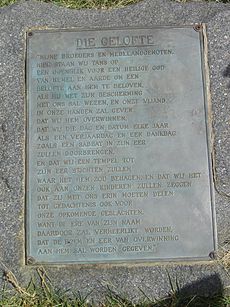
  • Afrikaans: Hier staan ons voor die Heilige God van Hemel en aarde om ʼn gelofte aan Hom te doen, dat, as Hy ons sal beskerm en ons vyand in ons hand sal gee, ons die dag en datum elke jaar as ʼn dankdag soos ʼn Sabbat sal deurbring; en dat ons ʼn huis tot Sy eer sal oprig waar dit Hom behaag, en dat ons ook aan ons kinders sal sê dat hulle met ons daarin moet deel tot nagedagtenis ook vir die opkomende geslagte. Want die eer van Sy naam sal verheerlik word deur die roem en die eer van oorwinning aan Hom te gee.
  • English: We stand here before the Holy God of heaven and earth, to make a vow to Him that, if He will protect us and give our enemy into our hand, we shall keep this day and date every year as a day of thanksgiving like a sabbath, and that we shall build a house to His honour wherever it should please Him, and that we will also tell our children that they should share in that with us in memory for future generations. For the honour of His name will be glorified by giving Him the fame and honour for the victory.
History

Day of the Vow

Photo: Renier Maritz / CC-BY-SA-3.0 / en.wikipedia.org

The official version of the event is that a public vow was taken – The Covenant Vow on Sunday, 09th Dec. 1838 – It was at this Wasbank laager where Pretorius, Landman and Cilliers formulated “The Vow” and recorded by Bantjes (pages 54-55 of his journal – location of Wasbank, S28° 18′ 38.82 E30° 8′ 38.55). The original Bantjes words from the journal read as follows; “Sunday morning before service began, the Commander in Chief (Pretorius) asked those who would lead the service to come together and requested them to speak with the congregation so that they should be zealous in spirit, and in truth, pray to God for His help and assistance in the coming strike against the enemy, and tell them that Pretorius wanted to make a Vow towards the Almighty (if all agreed to this) that “if the Lord might give us victory, we hereby promise to found a house (church) as a memorial of his Great Name at a place (Pietermaritzburg) where it shall please Him”, and that they also implore the help and assistance of God in accomplishing this vow and that they write down this Day of Victory in a book and disclose this event to our very last posterities in order that this will forever be celebrated in the honour of God.”

This bound future descendants of the Afrikaner to commemorate the day as a religious holiday (sabbath) in the case of victory over the Zulus by promising to build a church in God’s honour. By July 1839 nothing had yet been done at Pietermaritzburg regarding their pledge to build a church, and it was Jan Gerritze Bantjes himself who motivated everyone to keep that promise. In 1841 with capital accumulated by Bantjes at the Volksraad, the Church of the Vow at Pietermaritzburg was eventually built – the biggest donor being the widow, Mrs. H.J.van Niekerk in Sept. 1839.

As the original vow was never recorded in verbatim form, descriptions come only from the diary of Jan Bantjes with a dispatch written by Andries Pretorius to the Volksraad on 23 December 1838; and the recollections of Sarel Cilliers in 1871. A participant in the battle, Dewald Pretorius also wrote his recollections in 1862, interpreting the vow as including the building of churches and schools (Bailey 2003:31).

Jan B. Bantjes (1817–1887), Pretorius’ secretary, indicates that the initial promise was to build a House in return for victory. He notes that Pretorius called everyone together in his tent, (the senior officers) and asked them to pray for God’s help. Bantjes writes in his journal that Pretorius told the assembly that he wanted to make a vow, “if everyone would agree” (Bailey 2003:24). Bantjes does not say whether everyone did so. Perhaps the fractious nature of the Boers dictated that the raiding party held their own prayers in the tents of various leading men (Mackenzie 1997:73). Pretorius is also quoted as wanting to have a book written to make known what God had done to even “our last descendants”.

Pretorius in his 1838 dispatch mentions a vow (Afrikaans: gelofte) in connection with the building of a church, but not that it would be binding for future generations.

we here have decided among ourselves . . . to make known the day of our victory . . . among the whole of our generation, and that we want to devote it to God, and to celebrate with thanksgiving, just as we . . . promised in public prayer

Contrary to Pretorius, and in agreement with Bantjes, Cilliers in 1870 recalled a promise (Afrikaans: belofte), not a vow, to commemorate the day and to tell the story to future generations. Accordingly, they would remember:

the day and date, every year as a commemoration and a day of thanksgiving, as though a Sabbath . . . and that we will also tell it to our children, that they should share in it with us, for the remembrance of our future generations

Cilliers writes that those who objected were given the option to leave. At least two persons declined to participate in the vow. Scholars disagree about whether the accompanying English settlers and servants complied (Bailey 2003). This seems to confirm that the promise was binding only on those present at the actual battle. Mackenzie (1997) claims that Cilliers may be recalling what he said to men who met in his tent.

Up to the 1970s the received version of events was seldom questioned, but since then scholars have questioned almost every aspect. They debate whether a vow was even taken and, if so, what its wording was. Some argue that the vow occurred on the day of the battle, others point to 7 or 9 December. Whether Andries Pretorius or Sarel Cilliers led the assembly has been debated; and even whether there was an assembly. The location at which the vow was taken has also produced diverging opinions, with some rejecting the Ncome River site for (Bailey 2003).

Commemorations of the Day of the Vow

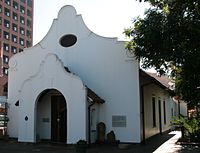
Church of the Vow, Pietermaritzburg

Photo: Theo V. BreslerUploaded by Theobresler at en.wikip / CC BY-SA 3.0 / en.wikipedia.org

Disagreements exist about the extent to which the date was commemorated before the 1860s. Some historians maintained that little happened between 1838 and 1910. Historian S.P. Mackenzie argues that the day was not commemorated before the 1880s. Initial observations may have been limited to those associated with the battle at Ncome River and their descendants. While Sarel Cilliers upheld the day, Andries Pretorius did not (Ehlers 2003).

In Natal

Informal commemorations may have been held in the homes of former Voortrekkers in Pietermaritzburg in Natal. Voortrekker pastor Rev. Erasmus Smit announced the “7th annual” anniversary of the day in 1844 in De Natalier newspaper, for instance. Bailey mentions a meeting at the site of the battle in 1862 (Bailey 2003:29,32).

In 1864 the General Synod of the Dutch Reformed Church in Natal decreed that all its congregations should observe the date as a day of thanksgiving. The decision was spurred by the efforts of two Dutch clergymen working in Pietermaritsburg during the 1860s, D.P.M. Huet and F. Lion Cachet. Large meetings were held in the church in Pietermaritzburg in 1864 and 1865 (Bailey 2003:33).

In 1866 the first large scale meeting took place at the traditional battle site, led by Cachet. Zulus who gathered to watch proceedings assisted the participants in gathering stones for a commemorative cairn. In his speech Cachet called for the evangelisation of black heathen. He relayed a message received from the Zulu monarch Cetshwayo. In his reply to Cetshwayo, Cachet hoped for harmony between the Zulu and white Natalians. Trekker survivors recalled events, an institution which in the 1867 observation at the site included a Zulu (Bailey 2003:35).

Huet was of the same opinion as Delward Pretorius. He declared at a church inauguration in Greytown on 16 December 1866 that its construction was also part of fulfilling the vow (Bailey 2003:35).

In the Transvaal

Die Zuid-Afrikaansche Republiek declared 16 December a public holiday in 1865, to be commemorated by public religious services. However, until 1877, the general public there did not utilise the holiday as they did in Natal. Cricket matches and hunts were organised, some businesses remained open, and newspapers were sold. The name Dingane’s Day appeared for the first time in the media, in an 1875 edition of De Volksstem. That newspaper wondered whether the lack of support for the holiday signalled a weakening sense of nationalism (Bailey 2003:37,38).

After the Transvaal was annexed by the British in 1877, the new government refrained from state functions (like Supreme Court sittings) on the date (Bailey 2003:41).

The desire by the Transvaal to retrieve its independence prompted the emergence of Afrikaner nationalism and the revival of 16 December in that territory. Transvaal burgers held meetings around the date to discuss responses to the annexation. In 1879 the first such a meeting convened at Wonderfontein on the West Rand. Burgers disregarded Sir G.J. Wolseley, the governor of Transvaal, who prohibited the meeting on 16 December. The following year they held a similar combination of discussions and the celebration of Dingane’s Day at Paardekraal (Bailey 2003:43).

Paul Kruger, president of the Transvaal Republic, believed that failure to observe the date led to the loss of independence and to the first Anglo-Boer war as a divine punishment. Before initiating hostilities with the British, a ceremony was held at Paardekraal on 16 December 1880 in which 5,000 burghers piled a cairn of stones that symbolized past and future victories (over the Zulu and the British).

After the success of its military campaign against the British, the Transvaal state organised a Dingane’s Day festival every five years. At the first of these in 1881, an estimated 12,000 to 15,000 people listened to speeches by Kruger and others (Gilliomee 1989). At the third such festival in 1891, Kruger emphasised the need for the festival to be religious in nature (Ehlers 2003).

In the Free State

The Free State government in 1894 declared 16 December a holiday (Bailey 2003).

National commemorations

The Union state in 1910 officially declared Dingane’s Day as a national public holiday.

In 1938 D.F. Malan, leader of the National Party, reiterated at the site that its soil was “sacred.” He said that the Blood River battle established “South Africa as a civilized Christian country” and “the responsible authority of the white race”. Malan compared the battle to the urban labour situation in which whites had to prevail (Ehlers 2003).

In 1952 the ruling National Party passed the Public Holidays Act (Act 5 of 1952), in which section 2 declared the day to be a religious public holiday. Accordingly, certain activities were prohibited, such as organized sports contests, theatre shows, and so on (Ehlers 2003). Pegging a claim on this day was also forbidden under section 48(4)(a) of the Mining Rights (Act 20 of 1967; repealed by the Minerals Act (Act 50 of 1991). The name was changed to the Day of the Vow in order to be less offensive, and to emphasize the vow rather than the Zulu antagonist (Ehlers 2003).

In 1961 the African National Congress chose 16 December to initiate a series of sabotages, signalling its decision to embark on an armed struggle against the regime through its military wing, Umkhonto we Sizwe.

In 1983 the South African government vetoed the decision by the acting government of Namibia to discontinue observing the holiday. In response, the Democratic Turnhalle Alliance resigned its 41 seats in Namibia’s 50-seat National Assembly.

Act 5 of 1952 was repealed in 1994 by Act No. 36 of 1994, which changed the name of the public holiday to the Day of Reconciliation.

Act 8 of 1995 offered a compensation to the families of the three Voortrekkers who were wounded.

Debates over the Holiday

Scholars like historian Leonard Thompson have said that the events of the battle were woven into a new myth that justified racial oppression on the basis of racial superiority and divine providence. Accordingly, the victory over Dingaan was reinterpreted as a sign that God confirmed the rule of whites over black Africans, justifying the Boer project of acquiring land and eventually ascending to power in South Africa. In post-apartheid South Africa the holiday is often criticised as a racist holiday, which celebrates the success of Boer expansion over the black natives.

By comparison with the large number of Afrikaners who participated in the annual celebrations of the Voortrekker victory, some did take exception. In 1971, for instance, Pro Veritate, the journal of the anti-apartheid organisation the Christian Institute of Southern Africa, devoted a special edition to the matter.

Historian Anton Ehlers traces how political and economic factors changed the themes emphasised during celebrations of the Day of the Vow. During the 1940s and 1950s Afrikaner unity was emphasised over against black Africans. This theme acquired broader meaning in the 1960s and 1970s, when isolated “white” South Africa was positioned against the decolonisation of Africa. The economic and political crises of the 1970s and 1980s forced white Afrikaners to rethink the apartheid system. Afrikaner and other intellectuals began to critically evaluate the historical basis for the celebration. The need to include English and “moderate” black groups in reforms prompted a de-emphasis on “the ethnic exclusivity and divine mission of Afrikaners” (Ehlers 2003).

Based on: Wikipedia

Related Blogposts

Mitsuo Fuchida ~ From Pearl Harbour to Calvary (2025)

Today marks the 84th anniversary of the attack on Pearl Harbour (1941-2025). Here is an article worth reading written . . .

By Dr. Peter Hammond. This Article is available as a PowerPoint with pictures, viewable here.

Mitsuo Fuchida (1902-1976) is best known for leading the devastating air attack on Pearl Harbour, 7 December 1941. After Mitsuo Fuchidathe war, Fuchida became a Christian Evangelist, who conducted Evangelistic outreaches throughout Japan, the United States and Europe.

Japanese Naval Aviator

Fuchida was the son of the Master of the Primary School in Kashihara. His grandfather was a Samurai. Mitsuo Fuchida entered the Imperial Japanese Naval Academy in 1921, graduated as a mid-shipman in 1924, was promoted to Ensign in 1925, and sub-Lieutenant in 1927. He specialised in horizontal bombing and gained combat experience during the Sino-Japanese War, when he was assigned to the aircraft carrier, Kaga, in 1929. Promoted to Lieutenant Commander in 1936, he was accepted into the Naval Staff College and joined the aircraft carrier Akagi in 1939, as Commander of the Air Group.

Attack on Pearl Harbour

Take of to Shokaku In October 1941, Fuchida was made Commander. Under the command of Vice Admiral Nagumo, with 6 aircraft carriers, and 423 aircraft, Commander Fuchida was responsible for the co-ordination of the aerial attack on the US Pacific Fleet. He was in the first wave of 183 dive-bombers, torpedo-bombers, level-bombers and fighters, which took off from carriers 370 km North of Oahu and targeted the US Pacific Fleet at Pearl Harbour. At 07:40 (Hawaiian Standard Time), Fuchida ordered “Tenkai!” (“Take attack position!”), slid back the canopy of his Nakajima Kate torpedo bomber and fired a green flare to signal attack. He then instructed his radio operator to send the coded signal “To, to, to” (“strike!”).

Tora! Tora! Tora!

At 7:53, Fuchida sent the code words “Tora!

Tora! Tora!” back to the carrier Akagi, the flagship, to report that complete surprise had been achieved. Tora was the acronym for Tosugeki Raigeki (torpedo attack) and in Japanese Tora means Tiger.

Attack at Dawn

Japan attack When the attack on Pearl Harbour hit, at 7:55am, many American sailors, or soldiers, were on leave, or sleeping late. 7 Battleships were lined up on battleship row. The Oklahoma capsized. The West Virginia and California was sunk. The Nevada was damaged and beached near the mouth of Pearl Harbour. Tennessee, Maryland and Pennsylvania were damaged. 10 Other ships were sunk or seriously damaged. The Arizona sank with 2,000 sailors on board, after a stupendous explosion of its forward magazine. (Just 8 days earlier, the Americans had published a picture of the Arizona with the words: “It is significant that despite the claims of air enthusiasts, no battleship has yet been sunk by bombs.” Pride goes before a fall.)

Attack on Pearl Harbour 7 December 1941 As the first wave returned to the carriers, Fuchida remained over the target to access damage and to observe the second wave attack. He returned to his carrier only after the second wave had completed its mission. 21 large flack holes were found in his aircraft, the main control wires were barely holding together and it is incredible that he survived so many hits to his aircraft. The Japanese lost 29 aircraft in the attack on Pearl Harbour. The US Pacific Fleet lost 21 ships including almost every battleship – 188 aircraft destroyed, another 159 damaged and 2,403 lives lost. In Fuchida’s Memoirs, he remarks being upset by the Admiral’s cancelling of the third wave attack, which would have destroyed Pearl Harbour’s fuel tanks and dry dock facilities. “I was upset and thought, ‘What stupidity!’ But the decision belonged to the Commander. It would not do any good if I complained.”. Years later, Fuchida said that while he mourned those who died aboard the USS Arizona and other ships, he did not regret his role in the Pearl Harbour attack. It was war, he said. After the successful Pearl Harbour attack, Fuchida was granted an audience with the Emperor.

Wounded at Midway

Pearl Harbour bombing On 19 February 1942, Fuchida led the first of two waves of 188 aircraft in an air raid on Darwin, Australia. On 5 April, he led another series of air attacks against the Royal Navy bases in Ceylon. In June 1942, Fuchida was recovering from an emergency shipboard appendectomy, when he was wounded at the Battle of Midway. He was on the ship’s bridge during the morning attacks by US aircraft. As Akagi was hit, a chain reaction from the burning fuel and live bombs began the destruction of the ship. An explosion threw him to the deck and he broke his ankle.

A Hand of Protection

Captain Fuchida After recuperation Fuchida spent the rest of the war as a staff officer. Two weeks before the American invasion of Guam, Fuchida was ordered to Tokyo. When the Japanese failed to repel the invasion, Vice Admiral Kakuta and his staff chose Seppuku, the Samurai suicide ritual of disembowelment. “Again the sword of death had missed me only by inches.” Fuchida declared. “What did it mean?”

Hiroshima Bombing

The day before the first atom bomb was dropped on Hiroshima, he was in that city to attend a conference. A long distance call from naval headquarters required him to return to Tokyo. As he ate breakfast in Yamato, 200km away, Fuchida learned that everyone he had been working with in Hiroshima had perished in the atomic explosion. The day after the atomic bombing, he returned to Hiroshima to access the damage. All of the members of Fuchida’s party died of radiation poisoning, but Fuchida exhibited no symptoms. Each of the Officers who had accompanied Fuchida, to investigate the devastation in Hiroshima, showed strange signs of illness. One by one they died through radiation poisoning. As Fuchida returned to Kashirhara, to help his wife raise their children, he was depressed: “Life had no taste, or meaning I had missed death so many times and for what. What did it all mean?”

War Crimes Trials

After the war, Fuchida was called to testify at the trials of Japanese military leaders. When General Douglas McArthur summoned Fuchida to testify in the Tokyo War Crimes trials, Captain Fuchida was disgusted and declared that everyone should know that “War was war” and that cruel acts occurred on both sides. The petty vindictiveness of the Allies infuriated him and he denounced the “victor’s justice.”

Love For One’s Enemies

In 1947, he met his former flight engineer, Kazuo Kanegasaki, who he thought had died in the Battle of Midway. However Kanegasaki reported that a young Christian woman, Peggy Covell, had cared for them, in the prison camps, despite her Missionary parents having been killed by Japanese soldiers on the Island of Panay, in the Philippines. Peggy Covell’s parents were Missionary teachers in Japan until 1939. They then relocated to the Philippines. The Japanese conquered the Philippines in 1941. They beheaded both of Peggy’s parents on Sunday morning, 19 December 1943. To Fuchida, this love for one’s enemies was inexplicable as the Bushido code required revenge against the murder of one’s parents to restore honour. He became obsessed with trying to understand why anyone would treat their enemies with kindness and forgiveness.

Inspiring Example

The extraordinary example of Peggy Covell inspired Fuchida to know more about the God of the Christians. When Japanese Prisoners of War asked the young 18-year old Peggy Covell why she volunteered to help them, her reply was: “Because Japanese soldiers killed my parents.” When Peggy considered her parent’s sacrificial service for the Kingdom of God, and their love for the Japanese people, she was convinced that she must continue their Mission, reaching Japanese for Christ. As Fuchida researched from every source in the Philippines that knew the Covells, he learned that they had been forced to their knees by their captors and they had prayed together as they were about to be beheaded. They had prayed for the Japanese!

Literature Evangelism

In 1948, as Fuchida was passing by the bronze statue of Hachiko at the Shibuya station, he was handed a pamphlet about the life of Jacob De Shazer, a member of the Doolittle Raid, who was captured when his B-25 bomber ran out of fuel in occupied China. In the pamphlet: “I was a Prisoner of Japan”, De Shazer, a former US Army Air Force staff sergeant and bombardier, related his testimony of imprisonment, torture and awakening to God.

Doolittle Raid Bombers

Doolittle Jacob De Shazer was the bombardier of B-25 No.16. After taking off from USS Hornet and dropping bombs on Nagoya, Japan, they flew to China, but ran out of fuel over Japanese controlled China. They were captured after parachuting to the ground. De Shazer was imprisoned for 40 months, 34 of these months in solitary confinement. He was beaten, malnourished and 3 of his crew were executed by firing squad. The fourth member, Lt. Bob Meder died of starvation. After 25 months of hating his captives, a Bible came into his hands, for only three weeks, but it changed his life completely. He began to learn Japanese and to treat his captives with respect. He resolved to bring the Message of Christ to Japan. After returning to the USA, De Shazer attended Seattle Pacific College and returned to Japan to preach the Gospel. He established a church in Nagoya, the very city he had bombed years before. Fuchida became intrigued with the Christian Faith. The shocking examples of Christians able to forgive their enemies staggered Fuchida. “That’s when I met Jesus. Looking back I can see now that the Lord had laid His hand upon me so that I might serve Him.”

The Power of the Printed Page

Fuchida read the tract on the spot and on the train he saw an advertisement for a book with the same title. When he disembarked, he headed for a book store and purchased it. De Shazer’s story engrossed Fuchida. Determined to understand what had motivated De Shazer, Fuchida bought a Bible from a Japanese man on the street. When he read “Father, forgive them, for they do not know what they are doing.” (Luke 23:24), Fuchida realised that this was what the Covells had been praying before their execution.

Faith Comes From Hearing the Word of God

In 1949, Fuchida purchased a Bible at the same Shibuyu station where he had received a pamphlet. As he read the Gospels he came to understand the reason for the life of forgiveness and mercy that motivated Peggy and Jacob. It was the crucifixion of Jesus and His Words in the Gospel: “Father, forgive them, for they do not know what they are doing.” On 14th April 1950, he surrendered to Jesus Christ as his Lord and Saviour.

The Power of God

By the time he had completed reading the Gospel of Luke, Fuchida had become a Christian. He knew no Christians, but now he began to declare himself to be a Christian. As Christianity was considered the “occupation religion” in Japan, this brought him much reproach from his former friends and family. Pietsch and Glenn Wagner, of the Pocket Testament League of Japan met with Fuchida and encouraged him to join them in open air outreach.

Open Air Preaching

Open air preaching In the business section of Osaka, as the Americans stood to speak, fewer than 40 Japanese would stop to listen. But when Fuchida, Hero of Pearl Harbour, was introduced, the crowd swelled rapidly. Rush hour traffic stopped. Hundreds gathered, even the police listened in.

Japan for Christ

This was the beginning of Fuchida’s new career as an Evangelist. Soon he filled an auditorium in Osaka, 500 Japanese came forward at that rally. Almost every newspaper in Japan reported on it: He described his conversion as “It was like having the sun rise.” He preached against Japanese-egocentrism and xenophobia. Like Paul on Mars Hill (Acts 17:16-34), he used Japanese cultural examples to communicate the Gospel of Christ. Captain Fuchida went from being a vital part of Japan’s military attack on the United States, to being a vital part of God’s Missionary offensive into the hearts, minds and souls of Japanese, and later Americans and Europeans too.

Fuchida and De Shazer

Fuchida and De Shazer In May 1950, Fuchida and De Shazer met for the first time. In May he visited De Shazer, knocked on his door and said: “I have desired to meet you, Mr De Shazer. My name is Mitsuo Fuchida.” De Shazer recognised the name and said: “Come in! Come in!” The former enemies embraced as brothers in Christ.

War Author

Midway In 1951, Fuchida published an account of the Battle of Midway and in 1952 he toured the United States as a member of the Worldwide Christian Missionary Army of Sky Pilots. In February 1954, Readers Digest published Fuchida’sCaptain Fuchida story of the attack on Pearl Harbour. Fuchida wrote – From Pearl Harbour to Golgotha (later renamed – From Pearl Harbour to Calvary) and a 1955 expansion of his book: Midway The Battle that Doomed Japan, the Japanese Navy Story. His autobiography – For That One Day, The Memoirs of Mitsuo Fuchida, Commander of the Attack on Pearl Harbour, was published in Japan 2007 and translated into English and published in 2011.

The Turning Point

In Midway: The Battle that Doomed Japan, Fuchida wrote: “Five minutes! Who would have believed that the tide of battle would shift in that brief interval of time? … We have been caught flat-footed in the most vulnerable position possible, decks loaded with planes armed and fuelled for attack.”

Courage and Self-Sacrifice

Fuchida turned down an offer from the Japanese government to organise their new Air Force, he faced down an angry pilot who pulled a knife and threatened to kill him. This man later came to Christ. Fuchida ministered in prisons and led people to Christ, even in the cells of condemned murderers. He formed Calvary Clubs in prisons.

The Blood of the Martyrs

The Covells Mitsuo Fuchida related the testimony of Peggy Covell and her brave parents all over Japan. He quoted her testimony: “But the Holy Spirit has washed away my hatred and has replaced it with love.” The Covells had gone to their death singing hymns joyfully and praying for the conversion of their enemies. The Blood of the martyrs is the seed of the Church. Mitsuo Fuchida was one of the fruit of their Faith.

Fuchida spent the rest of his life as an Evangelist, taking the Gospel of Christ throughout Japan, the United States of America and Europe.

Dr. Peter Hammond

Reformation Society
P.O. Box 74 Newlands 7725
Cape Town South Africa
Tel: 021-689-4480,

Email: mission@frontline.org.za This e-mail address is being protected from spambots. You need JavaScript enabled to view it

Website: www.ReformationSA.org

Soli Deo Gloria

Armistice Day 2025

Lest We Forget. Armistice Day Centenary Armistice Day, which is also known as Remembrance Day or Poppy Day, is commemorated every year on 11 November and this year is its 107th year since the guns fell silent (1918 – 2025).

Armistice Day marks the armistice signed between the Allies of World War I and Germany at Compiègne, France, for the cessation of hostilities on the Remembrance DayWestern Front of World War I, which took effect at eleven o’clock in the morning — the “eleventh hour of the eleventh day of the eleventh month” of 1918. The armistice initially expired after a period of 36 days. A formal peace agreement was only reached when the Treaty of Versailles was signed the following year.[1]

In South Africa one of the first instances where this tradition was honoured was at a church service in Cape Town. The city was in mourning after the publication of South Africa’s first casualty list from Word War I in 1916. A local businessman, Mr. J.A. Eggar, proposed that the congregation at a church service should keep a minute’s silence to honour the ‘Fallen.’ At the time it received no publicity.

Cape Town two-minute silence 1918 (Pic: SA History Online)On 27 October 1919, the famous South African author[2], politician and mining financier, Sir James Percy FitzPatrick proposed through Lord Milner, the former High Commissioner for South Africa, the idea of a two-minute silence, which proposition was presented to King George V that a moment of silence be observed annually on November 11 in honour of the dead of World War I. This had been a daily practice in Cape Town from April 1918 onward, since being proposed by Sir Harry Hands[3]. On 17 November, King George proclaimed that ‘at the hour when Armistice came into force, the 11th hour of the 11th day of the 11th month, there may be for the brief space of two minutes a complete suspension of all our normal activities . . . so that in perfect stillness, the thoughts of everyone may be concentrated on reverent remembrance of the glorious dead.’

Delville-wood, 1916 First World War Trenches People observe a one or more commonly a two-minute moment of silence at 11:00 a.m. local time. It is a sign of respect for, in the first minute, the estimated 20 million people who died in the war (1914-1918), and in the second minute dedicated to the living left behind, generally understood to be wives, children and families left behind but deeply affected by the conflict.

images images-1

We remember all who have given their lives in both the World Wars I & II and all other wars of conflict around the world, not forgetting the South African soldiers who lost their lives in WWI&II, the Border War and the Rhodesian Bush War defending all people groups against communism and socialistic tyranny.

13  Greater love hath no man than this, that a man lay down his life for his friends. ~ John 15:13

16  Hereby perceive we the love of God, because he laid down his life for us: and we ought to lay down our lives for the brethren. ~ 1 John 3:16

Memorial Wall

However, there is another war that rages on daily and this conflict is for the souls of men. As millions of unsaved souls have been lost in past wars, as Christians we are commissioned to reach the souls of men who stand upon the edge of hell and damnation in the eternal lake of fire which is the second death (read Revelation 20:14, 21:8). For as a Christian this Scripture is true, “For we wrestle not against flesh and blood, but against principalities, against powers, against the rulers of the darkness of this world, against spiritual wickedness in high places (Ephesians 6:12). And, “For though we walk in the flesh, we do not war after the flesh: (For the weapons of our warfare are not carnal, but mighty through God to the pulling down of strong holds;) (2 Corinthians 10:3,4).

For we have been warned,

17  For the time is come that judgment must begin at the house of God: and if it first begin at us, what shall the end be of them that obey not the gospel of God?
18  And if the righteous scarcely be saved, where shall the ungodly and the sinner appear? ~ 1 Peter 4:17,18

22  And of some have compassion, making a difference:
23  And others save with fear, pulling them out of the fire; hating even the garment spotted by the flesh. ~ Jude 22,23

15  And he [JESUS] said unto them, Go ye into all the world, and preach the gospel to every creature.
16  He that believeth and is baptized shall be saved; but he that believeth not shall be damned.
~ Mark 16:15,16

Soli Deo Gloria____________________

Related Blog-post: Remembrance Day 2015

Sources: King James Bible, Wikipedia, SAMVOA (South African Military Veterans Organisation of Australasia)

1 Shushkewich, Val (12 September 2005). The real Winnie : a one-of-a-kind bear. Natural Heritage Books. p. 42. ISBN 9781554883509.

2 Author of Jock of the Bushveld. Originally published in 1907. 

3 “Cape Town’s WWI Mayor – Sir Harry Hands” (PDF). wordpress.com.

The Gunpowder Plot – Guy Fawkes (Repost 2025)

C. H. Spurgeon The Daily Devotion by C. H. Spurgeon makes reference on this day to the Gunpowder Plot against King James I which today is “celebrated” as Guy Fawkes Night.

November 5

Morning

“No weapon that is formed against thee shall prosper.”
– Isa 54:17

17  No weapon that is formed against thee shall prosper; and every tongue that shall rise against thee in judgment thou shalt condemn. This is the heritage of the servants of the LORD, and their righteousness is of me, saith the LORD. ~ Isaiah 54:17

This day is notable in English history for two great deliverances wrought by God for us. On this day the plot of the Papists to destroy our Houses of Parliament was discovered, 1605.

“While for our princes they prepare
In caverns deep a burning snare,
He shot from heaven a piercing ray,
And the dark treachery brought to day.”

And secondly-to-day is the anniversary of the landing of King William III, at Torbay, by which the hope of Popish ascendancy was quashed, and religious liberty was secured, 1688.

This day ought to be celebrated, not by the saturnalia of striplings, but by the songs of saints. Our Puritan forefathers most devoutly made it a special time of thanksgiving. There is extant a record of the annual sermons preached by Matthew Henry on this day. Our Protestant feeling, and our love of liberty, should make us regard its anniversary with holy gratitude. Let our hearts and lips exclaim, “We have heard with our ears, and our fathers have told us the wondrous things which thou didst in their day, and in the old time before them.” Thou hast made this nation the home of the gospel; and when the foe has risen against her, thou hast shielded her. Help us to offer repeated songs for repeated deliverances. Grant us more and more a hatred of Antichrist, and hasten on the day of her entire extinction. Till then and ever, we believe the promise, “No weapon that is formed against thee shall prosper.” Should it not be laid upon the heart of every lover of the gospel of Jesus on this day to plead for the overturning of false doctrines and the extension of divine truth? Would it not be well to search our own hearts, and turn out any of the Popish lumber of self-righteousness which may lie concealed therein?

Gunpowder Plot and your KJV Bible

Guy Fawkes Gun-powder Plot. A late 17th or early 18th century report of the plot.Issue Date: May/June 2013

While the U.S. has its Fourth of July, complete with fireworks and revelry, England also has November 5 and it appears their celebration outdoes the USA’s. All over the country “bonfire societies” field multiple parades complete with massive firework displays. One example in the news recently was a small town of 16,000 called Lewes, which hosts some 60,000 visitors who joined the festivities.

So, what is so special about November 5? It’s Guy Fawkes Day!

Those who know the history of the holiday, know the significance of the “gunpowder plot” that got Fawkes and some of his buddies executed. But, if Fawkes had succeeded in igniting the fuse to 36 barrels of gunpowder, you and I might have a very different Bible to read today.

The year was 1605, just 6 years before the publication of the King James Bible that became the standard English scriptures for some 400 years. King James had been petitioned by the Puritans to authorize the translation of a “new and completely accurate” English Bible. He immediately commissioned over 50 scholars from Oxford and Cambridge to begin the work. The men chosen were the most learned of their day not only in linguistics but biblical theology. Many of them were fluent in up to 14 languages.

All this was happening in the middle of a pitched battle between the leaders of the Reformation and the Vatican. And the Bible was the prize in that war. For over 100 years the Reformers had fought to print the Bible in the language of the people. The Vatican had commissioned the Jesuits and the Dominicans with the task of destroying those Bibles. Politics had become one of the battlefields with the rulers of England alternating between Protestant and Catholic.

At this point, King James was Protestant and almost literally had a bull’s eye on his back. Jesuit agents cooked the “gunpowder plot” to tunnel under the Parliament building and set off a massive explosive while it was in session. Their hope was to kill King James and as many of the Members of Parliament as possible.

Guy Fawkes was enlisted by the pope to carry out the plan. He and about half-a-dozen other men started the tunnel and eventually positioned 36 barrels of gunpowder in place. In their attempt to carry out their plan, they met one problem after another so that, looking back, the Lord was surely toying with their little plan. During the digging, they hit an unexpected wall underground. But a cellar was discovered that gave them the required access. Next, Parliament delayed meeting for several months and the powder got wet and had to be replaced. Finally one of the men wrote a letter warning a Catholic friend to stay away from the building on a certain date. The letter ended up in the hands of the king who discovered the scheme just hours before the targeted meeting.

November 5 was legislated a national day of thanksgiving for deliverance from “papists.” Today, it is celebrated as a fun festival with few recognizing the continued dangers of Roman Catholicism. But had the pope not lost that battle, you and I might be reading a Roman Catholic Bible, if we were even allowed to possess one.

But the story of the war waged by the Vatican to stop God’s word for the common people is not over. Today gunpowder is not the weapon of choice, it is ecumenism and polluted bibles. David W. Daniels explains many fascinating details of this 500-year war and the present state of hostilities, in his book, Did the Catholic Church Give Us the Bible?, available from Chick Publications.

Gunpowder treason and plot

The Gunpowder Plot of 1605, in earlier centuries often called the Gunpowder Treason Plot or the Jesuit Treason, was a failed assassination attempt against King James I by a group of provincial English Catholics led by Robert Catesby.

The plan was to blow up the House of Lords during the State Opening of Parliament on 5 November 1605, as the prelude to a popular revolt in the Midlands during which James’s nine-year-old daughter, Elizabeth, was to be installed as the Catholic head of state. Catesby may have embarked on the scheme after hopes of securing greater religious tolerance under King James had faded, leaving many English Catholics disappointed. His fellow plotters were John and Christopher Wright, Robert and Thomas Wintour, Thomas Percy, Guy Fawkes, Robert Keyes, Thomas Bates, John Grant, Ambrose Rookwood, Sir Everard Digby and Francis Tresham. Fawkes, who had 10 years of military experience fighting in the Spanish Netherlands in the failed suppression of the Dutch Revolt, was given charge of the explosives.

Monteagle letter. An anonymous letter, sent to William Parker, 4th Baron Monteagle, was instrumental in revealing the plot's existence. Its author's identity has never been reliably established, although Francis Tresham has long been a suspect. Monteagle himself has been considered responsible, as has Salisbury The plot was revealed to the authorities in an anonymous letter sent to William Parker, 4th Baron Monteagle, on 26 October 1605. During a search of the House of Lords at about midnight on 4 November 1605, Fawkes was discovered guarding 36 barrels of gunpowder—enough to reduce the House of Lords to rubble—and arrested. Most of the conspirators fled from London as they learned of the plot’s discovery, trying to enlist support along the way. Several made a stand against the pursuing Sheriff of Worcester and his men at Holbeche House; in the ensuing battle, Catesby was one of those shot and killed. At their trial on 27 January 1606, eight of the survivors, including Fawkes, were convicted and sentenced to be hanged, drawn and quartered.

Details of the assassination attempt were allegedly known by the principal Jesuit of England, Father Henry Garnet. Although he was convicted of treason and sentenced to death, doubt has been cast on how much he really knew of the plot. As its existence was revealed to him through confession, Garnet was prevented from informing the authorities by the absolute confidentiality of the confessional. Although anti-Catholic legislation was introduced soon after the plot’s discovery, many important and loyal Catholics retained high office during King James I’s reign. The thwarting of the Gunpowder Plot was commemorated for many years afterwards by special sermons and other public events such as the ringing of church bells, which have evolved into the Bonfire Night of today.

The following poem has been handed down through time, elements of which are still reiterated even today. It sums up how the Protestants felt about the events that unfolded on that day in 1605:

“Remember, remember!
The fifth of November,
The Gunpowder treason and plot;
I know of no reason
Why the Gunpowder treason
Should ever be forgot!

Guy Fawkes and his companions
Did the scheme contrive,
To blow the King and Parliament
All up alive.
Threescore barrels, laid below,
To prove old England’s overthrow.
But, by God’s providence, him they catch,
With a dark lantern, lighting a match!

A stick and a stake
For King James’s sake!
If you won’t give me one,
I’ll take two,
The better for me,
And the worse for you.

A rope, a rope, to hang the Pope,
A penn’orth of cheese to choke him,
A pint of beer to wash it down,
And a jolly good fire to burn him.
Holloa, boys! holloa, boys! make the bells ring!
Holloa, boys! holloa boys! God save the King!
Hip, hip, hooor-r-r-ray!”

However, true Christians do not condone the violent language that is reflected in this poem especially in the last stanza.

This villainous plot had everything to do with King James the 1st’s commission of the “Authorised Version” of the Holy Bible, known as the King James Bible, in 1604 and the gunpowder plot took place in 1605.

Soli Deo Gloria

________________________________

Sources: Chick.com Publications and Wikipedia

The Ark and the Darkness

The leading evidences for Noah’s Flood! Enjoy the Ark and the Darkness, full-length version! See more about the movie here: www.noahsflood.com and order the movie and book resources here: www.genesisapologetics.com/ark

Create your own website, free on WordPress.com.Create your own website.
Start free